
Held on Wednesday 29-Jul-2026, the Weird & Wonderful Electronics show & tell items. The invites were soooo comprehensive, please refer to the bottom of the post for what the members had to read to get ready for this event.
From Mal VK2TMF
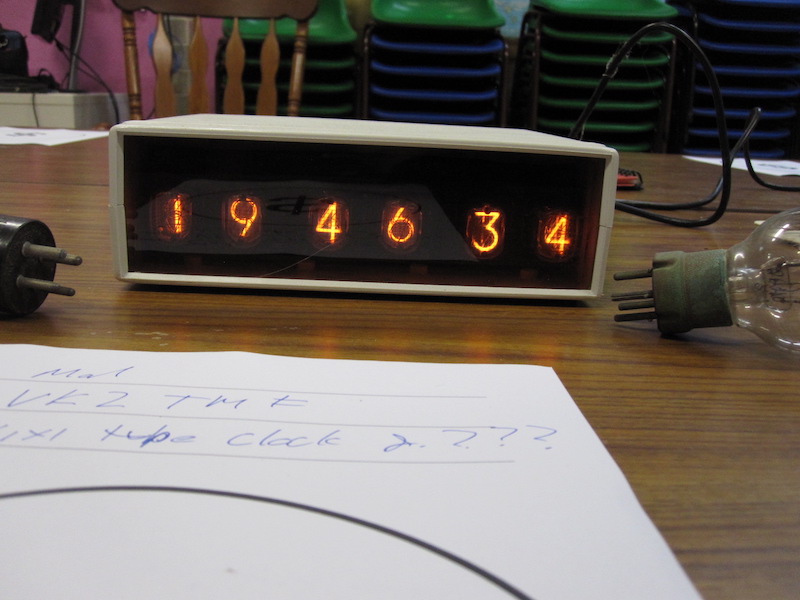
A clock and 2 unknown tubes.
From Clifford VK2CLF
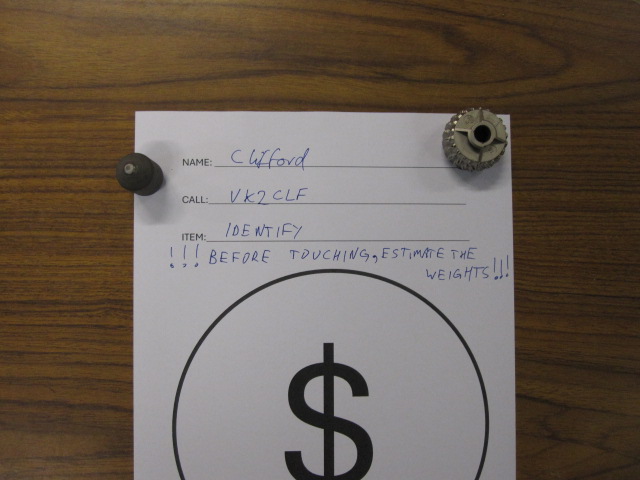
The items demonstrate the importance of modern metallurgy. They are a golfball typewriter head of magnesium alloy weighing 12g, and a tungsten electrode from a film studio arc lamp, weighing 156g.
I was hoping to find the tungsten/copper cathode from X-ray tube that got dropped and broken when I took it to school for show&tell in 1971. It was from the first privately-owned Roentgen-apparat in Australia, imported by my grandfather in 1924, which was instrumental in his role in modernising dental care in Australia. Unfortunately it is still roaming free in the untamed wilderness of my extensive junk collection.
From Dean VK2DAC
Spark generator for testing tolerance of equipment … or victim board!

From Nick VK2FS
Trash & Treasury items and more with funny stories! Including a SWR/Power metre built during a 10hr ferry trip with the soldering iron plugged on the “shaver only” plug outlet.

From Carmel VK2NO
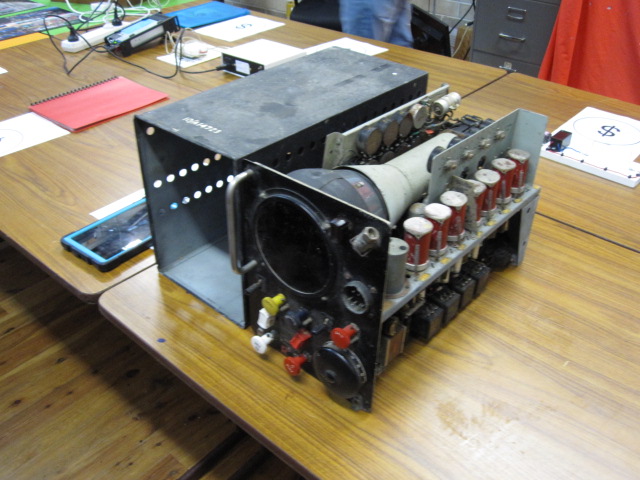
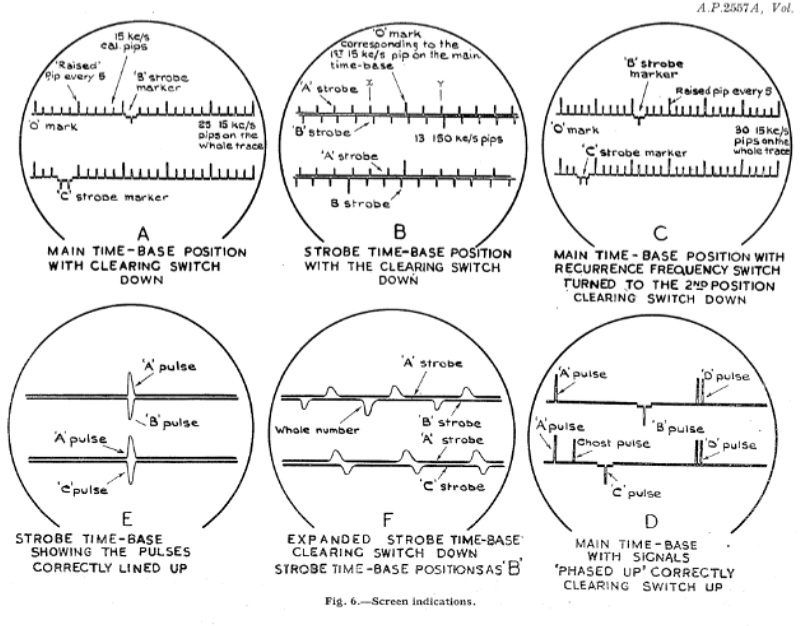
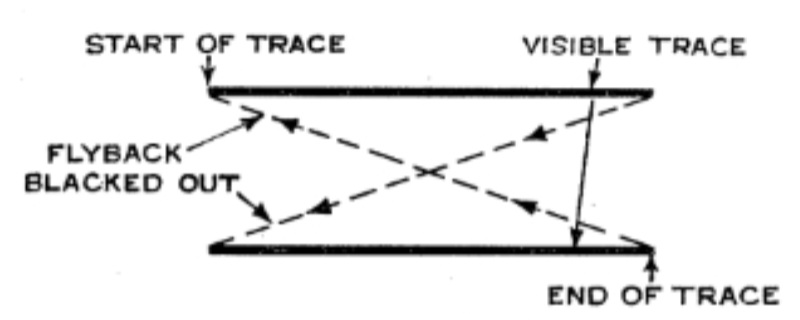
Gee, or ‘G’ for ‘grid’ is a WWII navigation aid to help night bomber pilots find their way back home. It uses time delay pulses between two or more radio signals located at different positions in order to get a fix by use of hyperbole navigation, where receiver curve plots intersect to get a result. Distances up to 300 miles could be covered. Pulses are displayed on an ‘oscillograph’ connected to the receiver and on-screen pulse aligment between stations aids the navigator. These devices were used on heavy bombers and receive across a wide VHF bandwidth. This early navigation system inspired the later LORAN systems which operated at lower frequencies for greater distance.
More here…
https://en.wikipedia.org/wiki/Gee_%28navigation%29
https://en.wikipedia.org/wiki/File:Hyperbolic_Navigation.svg
The GEE story related by Dad…
While my Mom drove trucks during WWII and worked in the plotting room and also operated radios, my father was an Australian Halifax night bomber pilot leading a British squadron, stationed at Driffield, Yorkshire. Dad made many wartime friends, one including navigator James who loved repairing radios and had obtained some gear post-war (and had given the GEE equipment to Mom many years later) as she was interested.
Where’s this leading? From what I recall Dad telling us when we were young, one day in Wheatey, Oxforshire during the late 60s, James answered a knock at the door. It was a student selling encyclopaedia Brittanicas.
James caught his accent and said something like, “Oh, you’re German?”
“Ya,” the student replied, “Studying in Oxford.”
James quipped, “I havn’t forgotten the war you know. And I’m not interested in your encyclopedies.”
The German salesman said, “There’s so much about the War in this complete set.”
James shook his head and said, “No.”
The student glanced past James and noticed the GEE equipment on a table behind. He says, “Ah, that looks like RAF equipment?”
James glared at him and replied, “Wouldn’t you lot like to know,” and slammed the door in his face.
Poor student 🙁
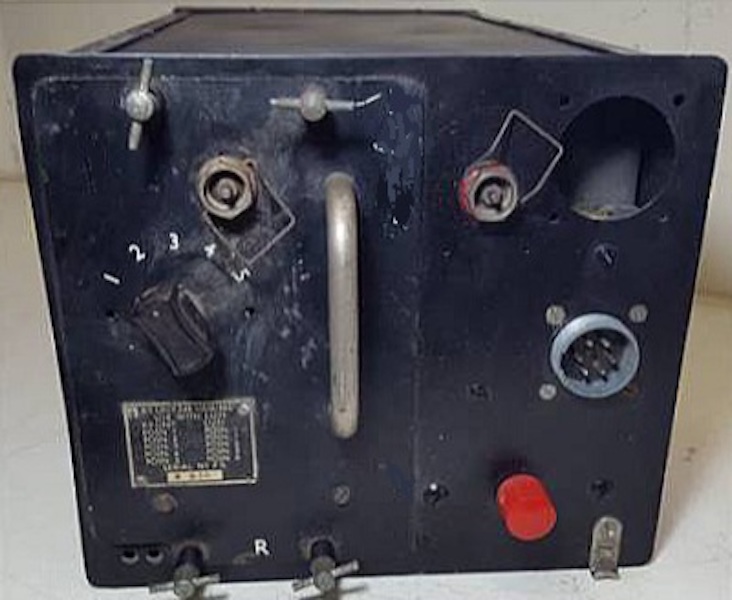
Too heavy to carry up as well, this is the aircraft receiver that hooks up to the GEE scope. It’s currently undergoing a restoration with capacitor stuffing and cleaning etc. There’s a ‘self destruct’ connector inside, for obvious reasons.
From Tim VK2TIJ
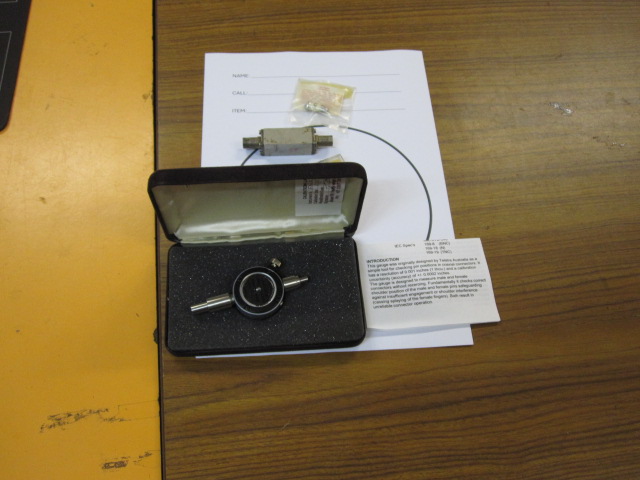
Couldn’t find the piece of resistance, so brought various rare items including an artificial aerial! Microwave diode (WWII) for radar, ammune to high RF. Gauge for BNC installation. Calibration capacitor.
From Geoff VK2WA
Great for possum and in-laws. Would make an amazing door bell.

From Glenn VK2GLE
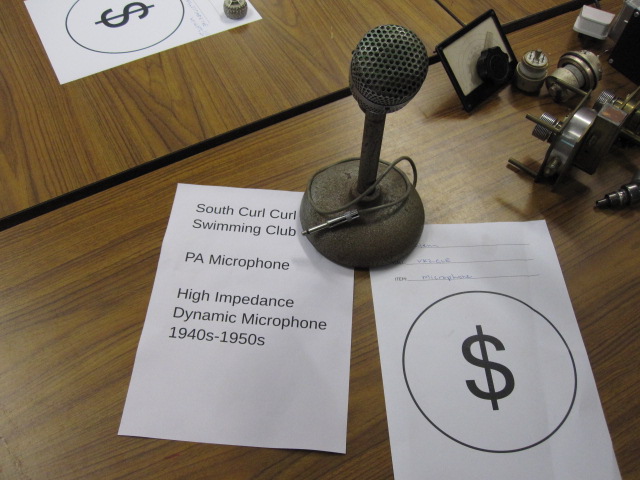
Vintage microphone from the Curl Curl pool, purchased n 1974 … with a story on how to get a trophy.
From Colin VK2JCC
Colin VK2JCC (aka Professor Portable) was once employed by AWA at North Ryde.
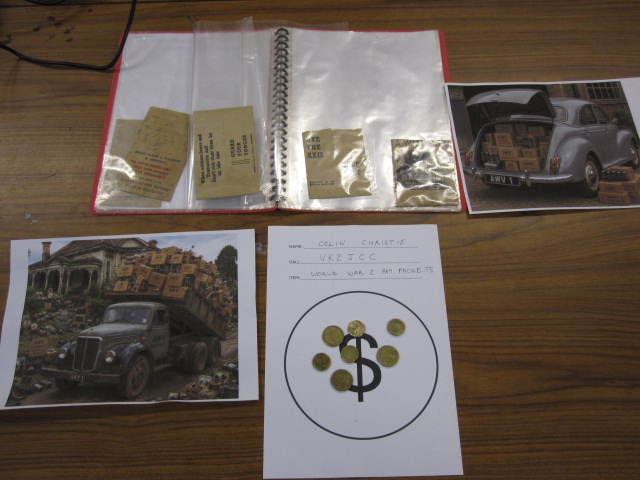
“One day after work it was mentioned that the late Fritz Langford home was being cleared of all his experiments and lots and lots of components and if interested, I should go now. Upon arrival a tip truck was leaving the premises the third one for the day loaded with valves and lots of components. I loaded my Morris Minor with thousands of valves to the point I could just sit in the driver’s seat and operate the pedals. He had resister stored in world war 2 pay packets which were showcased at the show and tell.”
From Richard VK2ARH
The Circle of Life – Amateur Radio Operators and their ‘Junk’
By Richard VK2ARH
(Punctuation is to assist vocal delivery and may not be grammatically correct)
It sits there on the garage shelf or in a storage box
It may be easily accessible, or held behind closed locks
But a simple piece of something – God knows only just what
But the owner knows exactly what it is, and what it is they’ve got
To those who loved this precious thing, a marvel to behold
Behind each favored bit of junk, there’s story’s to be told
Of times gone by and adventures had, with the item held so dear
That is the very reason, we’ve kept it oh so near
Despite the endless pressure, to clean out all that ‘stuff’
It’s just not stuff to those who know, especially the radio buff
Has it time on earth come to an end? – nay you need not fear
for there’s aways a use for that beautiful junk – no need to shed a tear
Enter the erudite Amateur, with all their hard-earned skills
and wide-ranging specialist knowledge, to solve life’s challenge and ills.
A piece of history or electronic junk, to some it may just be
But the Amateur enthusiast – it screams ‘POSSIBILITY’
It has connectors, knobs and dials, and components from the past
A quality of construction that’s clearly made to last
Its functionality and purpose, technology may have changed
But a future use awaits it, once masterly rearranged
With 3D printed fixtures and endless cheap supplies
Repurposed possibilities are always in our eyes
With skill and driven mindset and internet research
The erudite Ham won’t leave the junk, just resting on its perch.
But it may take many years, to finally decide
How best to use this treasure, so we keep it to one side.
We dream of how to use it, and keep it just in case
While possibilities just build up and fill our living space
One fateful day it becomes too much, our minds begin to race
With possibilities and options, we simply don’t want to face.
Then to ourselves we slowly admit, that all will not get used
So to the radio club it comes, for others to get enthused.
And so, the cycle starts again, we keep it from the tip
Selected by an erudite Ham, who plans its transforming trip.
But the process keeps the Amateur spirit, active, alive and well
We thrive on the challenge to repurpose, till we ring that fateful bell.
One final piece of wisdom and lesson to be learnt
to maintain the repurposed journey and ensure you don’t get burnt.
Your ‘Junk’ may have a future life and a possibly one day sell
but keep it nice and tidy, don’t upset the XYL.
or (depending upon Amateur Radio or Domestic Audience)
Your ‘Junk’ may be sold one day and have a future life
but keep it nice and tidy, and don’t upset the wife.
Richard VK2ARH
And the winners:
- Best display – Colin VK2JCC
- Best story – Nick VK2FS
- And the amount of people who couldn’t find what they would have liked to show!!!

… and the below were the invites leading to the evening!!!
Received Thu 16-Jul-2026
Less than 2 weeks to go for the 5th Wednesday competition. Strange and hard to find components, electronics etc.
Tell your friends!
Here is some food for thought to prompt your memory of the things you had long forgotten in the back of your draws / shack / shed / storage unit / mums place / hiding behind the couch / under the house… you get the idea..
Not exhaustive but just a few ideas.
Weird & Wonderful Electronics — 200 Items
MWRS 5th Wednesday Show and Tell
Display oddities
- Nixie tube — cold-cathode neon digit display
- Numitron — 7-segment display using glowing filaments
- VFD (vacuum fluorescent display) — blue-green glow, calculators and VCRs
- Magic eye tube — glowing “Pac-Man” tuning indicator
- Dekatron — glow-transfer counting tube, visibly spins as it counts
- Trochotron / Beam-X — magnetic beam-switching counter tube, faster than a Dekatron
- Panaplex — flat neon 7-segment, precursor to plasma TVs
- Nimo tube — mini CRT that projects one digit at a time
- Pixie tube — Nixie’s crude cousin, stencil-cut digits
- Minitron — incandescent 7-segment in a DIP package
- Charactron — CRT that shapes the beam through a letter stencil
- IEE one-plane projection readout — 12 tiny lamps and lenses per digit
- Flip-dot display — electromagnetic dots, still clacking in buses
- Edge-lit lightguide display — engraved perspex digits, lamp per layer
- E1T — decade counting tube with built-in display
- Storage CRT — Tektronix scopes that “held” the trace in phosphor
Weird computer memory
- Selectron tube — RCA’s 1940s vacuum-tube RAM
- Williams tube — stored bits as charge dots on a CRT face
- Mercury delay line — bits as sound waves in a tube of mercury (CSIRAC’s was Australian)
- Torsion wire delay line — 95 ft of coiled wire as calculator memory
- Magnetic core memory — grid of ferrite rings, hand-threaded
- Core rope memory — Apollo’s hand-woven read-only software
- Bubble memory — magnetic bubbles in a garnet film, 1980s
- Drum memory — spinning magnetic drum, the first hard “disk”
- Twistor memory — Bell Labs’ magnetic tape-wrapped wire
- Transfluxor — multi-hole ferrite core, analogue memory
- Plated-wire memory — core memory’s faster successor
- Wire recorder — audio on hair-thin steel wire
Strange tubes and switches
- Thyratron — gas-filled high-power switching tube
- Ignitron — mercury-pool switch handling thousands of amps
- Klystron — microwave amplifier tube
- Coherer — Marconi-era detector, metal filings in glass
- Memistor — 3-terminal electrochemical analogue memory
- Cryotron — superconducting switch
- Parametron — Japanese resonant logic element
- Vibrator power supply — buzzing HT inverter from valve car radios
- Subminiature valves — wire-ended tubes for hearing aids and fuzes
Microwave & RF tubes
- Magnetron — cavity oscillator, radar to microwave ovens
- Travelling-wave tube — helix amplifier, still in satellites
- Carcinotron — backward-wave oscillator, Cold War jammer
- Gyrotron — megawatt millimetre waves for fusion heating
- Acorn tube — 1930s VHF valve the size of an acorn
- Lighthouse tube — disc-seal UHF triode shaped like a lighthouse
- Nuvistor — thumbnail-size metal-ceramic valve, RCA’s last stand
- Compactron — three valves crammed in one envelope
Camera & photo tubes
- Iconoscope — first practical TV camera tube
- Image orthicon — the “Emmy” award’s namesake
- Vidicon — workhorse TV camera tube
- Photomultiplier — detects single photons
- Image intensifier tube — night-vision cascade tube
Gas & mercury devices
- Mercury-arc rectifier — glass octopus with a glowing mercury pool
- Excitron — single-anode mercury rectifier
- Tungar rectifier — argon-filled battery-charger bulb
- 0Z4 — cold-cathode gas rectifier from car radios
- VR tube — neon voltage regulator (VR105 etc.)
- Corona stabiliser tube — kilovolt regulation from corona discharge
- Cold-cathode trigger tube — neon logic before transistors
- Neon lamp ring counter — NE-2s doing arithmetic
- Barretter / ballast tube — iron wire in hydrogen as current regulator
- Geiger–Müller tube — the classic clicker
Semiconductor oddities
- Tunnel diode — negative resistance, GHz in 1958
- Gunn diode — microwave oscillator, no junction at all
- Point-contact transistor — the original 1947 kind
- OC71 glass transistor — scrape the paint, get a phototransistor
- Unijunction transistor — one junction, great sawtooth oscillator
- Shockley 4-layer diode — pre-thyristor latching switch
- Diac — the trigger inside every old dimmer
- Lambda diode — two FETs faking a tunnel diode
- Selenium rectifier — finned stack, smells awful when it dies
- Copper-oxide rectifier — pre-selenium metal rectifier
- Cat’s whisker galena detector — crystal radio’s heart
- Carborundum detector — the tougher crystal detector
- Raysistor / Vactrol — lamp + photocell optocoupler
- Solar “sun battery” — 1950s selenium photocells
Electromechanical wonders
- Strowger / uniselector switch — telephone exchange stepping switch
- Mercury-wetted relay — bounce-free contacts, position-sensitive
- Resonant reed relay — frequency-selective remote control
- Synchro / selsyn — AC shaft-angle transmitter
- Magnetic amplifier — saturable-core amplifier, no moving parts, no tubes
- Carbon pile regulator — voltage regulation by squeezing carbon discs
- Dynamotor — spinning HT supply for valve mobile rigs
- Vibrator chopper — the buzzing tin can before the dynamotor
- Rotary converter — motor and generator sharing one armature
- Ledex rotary solenoid — solenoid that twists instead of pulls
- Tuning-fork frequency standard — Accutron watches and telecom pilots
Early radio relics
- Spark gap transmitter parts — quenched gap stacks
- Marconi magnetic detector — clockwork-driven iron wire loop
- Electrolytic detector — platinum whisker in acid
- Poulsen arc converter — CW from a burning arc
- Alexanderson alternator — RF from a giant machine (one still runs in Sweden)
- Variometer — rotating coil-in-coil tuner
- Lecher lines — measuring wavelength with parallel wires
- Crystal earpiece — Rochelle salt piezo driver
Passive & mechanical oddballs
- Vacuum variable capacitor — glass/ceramic, kilovolt tuning
- Butterfly capacitor — tunes without rotating contacts
- Roller inductor — the “coil on wheels” in ATUs
- Gimmick capacitor — two twisted wires, that’s it
- “Bumblebee” / “dogbone” components — colour-banded caps and resistors
- Leyden jar — the original capacitor
- Thermocouple RF ammeter — measures RF by heating a junction
Position, motion & magnetic sensors
- LVDT — position sensing via a sliding transformer core
- Inductosyn — printed-circuit precision position scale
- String potentiometer — position from a spring-loaded cable reel
- Electrolytic tilt sensor — bubble level with electrodes
- Mercury tilt switch — blob of mercury as the contact
- Wiegand wire sensor — special wire that snaps its own magnetic pulse, needs no power
- Variable-reluctance sensor — coil + magnet, still timing every crankshaft
- Fluxgate magnetometer — saturable core compass
- Proton precession magnetometer — measures Earth’s field with a bottle of kerosene
- Geophone — moving-coil ground listener
- Hydrophone — piezo underwater ear
- Vibrating-wire strain gauge — strain read as a change in pitch
- Spinning-mass gyro — air-bearing mechanical marvel
- Tuning-fork piezo gyro — the gyro in early camcorders
- Ring laser gyro — rotation measured with counter-rotating light
Light, radiation & imaging
- Scintillation crystal + PMT — radiation flashes counted photon by photon
- Channeltron — single-channel electron multiplier horn
- Microchannel plate — millions of multiplier channels in a wafer
- Americium ionisation chamber — the radioactive heart of smoke detectors
- UVtron — gas tube that sees flame ultraviolet
- Golay cell — detects IR by gas expansion flexing a mirror
- Bolometer — light measured as heat in a blackened strip
- Thermopile detector — stacked thermocouples as an IR eye
- Pyroelectric detector — the crystal inside every PIR
- Image dissector tube — Farnsworth’s original TV camera tube
- Reticon array — early linear photodiode imaging chip
- Exciter lamp + photocell — how film soundtracks were read
- Monsanto MV1 — one of the first commercial red LEDs
Gas, chemical & humidity
- Pellistor — catalytic bead that warms up near flammable gas
- Taguchi sensor — heated tin-oxide gas sniffer
- Zirconia lambda sensor — oxygen sensing at exhaust temperature
- Clark electrode — dissolved-oxygen cell from medicine
- pH glass electrode — millivolt chemistry in a fragile bulb
- ISFET — a transistor that tastes
- Fuel-cell breathalyser cell — alcohol generates the signal current
- Lithium chloride dew cell — self-heating humidity sensor
- Hot-wire anemometer element — airflow cools a heated wire
Vacuum & pressure
- Pirani gauge — vacuum measured by heat loss from a filament
- Bayard–Alpert gauge — ionisation gauge for hard vacuum
- Capacitance manometer — pressure via a flexing metal diaphragm
- Radiosonde baroswitch — aneroid-driven contact bank from weather balloons
Time, frequency & standards
- OCXO — crystal in a thermostatted oven
- Rubidium frequency standard — atomic physics in a lunchbox
- Caesium beam tube — the actual definition of the second
- Weston standard cell — the volt in a glass H
- Kelvin–Varley divider — ppm-accurate voltage division by switches
- Vibrating-reed electrometer — femtoamps via a mechanical chopper
- Electrometer tube — valve with grid current in the femtoamps
- Light-beam galvanometer — mirror and lamp instead of a needle
- String galvanometer — recorded the first ECGs
Filters, delay & audio
- Collins mechanical filter — IF filtering with resonating metal discs
- Crystal lattice filter — quartz plates as a razor-sharp filter
- PAL glass delay line — 64 µs of ultrasound in a block of glass
- Bucket-brigade device — analogue samples passed hand-to-hand
- Spring reverb tank — echo from coiled springs
- Oil-can delay — audio stored electrostatically in oil
- Loading coil — the potted inductor that made long phone lines work
- Hybrid coil — the transformer that let one pair carry both directions
Microwave & RF modules
- Reflex klystron — single-cavity microwave oscillator
- TR cell — gas tube that protected radar receivers from their own transmitter
- Trigatron — triggered spark gap from radar modulators
- Pulse-forming network — capacitors and coils shaping megawatt pulses
- Ferrite circulator — one-way roundabout for microwaves
- Magic-T — waveguide junction that splits and isolates
- Parametric amplifier — low-noise gain from a pumped varactor
- Ruby maser — quantum amplifier that needed liquid helium
- Gunnplexer — Gunn diode transceiver head, ham 10 GHz favourite
- Varactor multiplier chain — microwatts to microwave by harmonic brute force
- Cavity wavemeter — frequency measured with a plunger and a dip
- Vacuum relay — kilovolt RF switching in a glass bottle
- Coaxial relay — chunky antenna changeover switch
High voltage & pulse
- Cockcroft–Walton multiplier — ladder of diodes and caps to megavolts
- TV EHT tripler — potted multiplier from colour TVs
- Krytron — cold-cathode tube for nanosecond switching, famously export-controlled
- Xenon flashtube — plus its quench tube in old strobes
- Piezo transformer — voltage step-up through a vibrating ceramic bar
- X-ray tube — dental ones are surprisingly small
Electromechanical & rotating
- Amplidyne — a generator used as a power amplifier
- Telechron rotor — sealed synchronous clock motor
- Nipkow disc — mechanical television’s spinning scanner
- Facsimile drum — photos by wire, one revolution per line
- Zenith Space Command remote — TV control by struck aluminium rods, no battery
- Turret tuner — TV channels changed by rotating coil biscuits
- Veeder-Root counter — electromagnetic digit wheels
- Cam-drum timer — washing machine program on a rotating drum
- Crossbar switch — telephone exchange matrix of bars and fingers
- Heat coil & carbon arrestor — telephone line lightning protection
- Pinball score motor — relay logic choreographed by cams
Computing & construction modules
- DEC Flip-Chip — one logic gate per plug-in card
- IBM SMS card — the module that built the mainframes
- IBM SLT module — hybrid ceramic squares, pre-IC
- Cordwood module — components stacked like firewood, potted solid
- Philbrick K2-W — the vacuum-tube op-amp that started it all
- Analog multiplier module — multiplication as a physical object
- Tektronix ceramic strips — the notched terminal strips inside classic scopes
Power & energy
- RTG — radioisotope heat to electricity, powers Voyager still
- Betavoltaic battery — decades of trickle power from beta decay
- Kerosene-lamp TEG — Soviet thermoelectric ring that ran a radio from lamp heat
- Air-depolarised cell — giant glass telephone battery breathing air
- Edison nickel–iron cell — the battery that refuses to die
Received Thu 21-Jul-2026
Weird & Wonderful Electronics — Items 201–400
MWRS 5th Wednesday Show and Tell — The Sequel
AND NOW FOR SOMETHING COMPLETELY DIFFERENT
NOBODY expects the Fifth Wednesday! Our chief weapon is surprise. Surprise, and obscure components. Our TWO chief weapons are surprise, obscure components, and an almost fanatical devotion to the junk box. AMONGST our chief weaponry…
*”This capacitor is no more. It has ceased to be. It’s expired and gone to meet its maker. Bereft of dielectric, it rests in peace. THIS… IS… AN EX-COMPONENT!”*
*”It’s not dead, it’s resting! Lovely tube, the Dekatron. Beautiful glow!”*
*”What is the forward voltage of an unladen germanium diode?” “African or European?” “I… I don’t know that. AAARGH.”*
And so, without further ado — He said “ado”! — items 201 through 400. Nobody expects them either.
The Tubes Strike Back
- Pentagrid converter — seven grids, one valve, does a whole front end
- Beam-deflection tube (7360) — balanced mixer by steering the beam
- Secondary-emission pentode (EFP60) — gain from electrons knocking out more electrons
- Phasitron — bizarre FM modulator tube with a spinning electron disc
- Resnatron — WWII jammer tube, continuously pumped by a vacuum plant
- Inductive output tube — klystron-triode hybrid, still in TV transmitters
- Split-anode magnetron — the magnetron before the cavity kind
- Monoscope — CRT with a test pattern printed inside it
- Skiatron — dark-trace CRT, drew radar in purple on white
- Graphechon — storage tube that converted radar scans for TV display
- Flying-spot scanner CRT — televised film by scanning light through it
- Fleming valve — the first diode, 1904
- de Forest Audion — the leaky, erratic first triode
- Soviet rod pentode — pencil-size valve built from rods, not grids
- Doorknob tube — early UHF power valve shaped like its name
- Peanut tube (WD-11) — 1920s battery valve, tiny and now pricey
- Multipactor tube — Farnsworth’s electron-multiplying oscillator dead end
- Thermionic converter — heat straight to electricity in a vacuum gap
- Saturated noise diode — a valve whose only job is to hiss
Lamps of Distinction
- Nernst lamp — glowing ceramic rod, needed pre-heating to start
- Zirconium arc lamp — near-perfect point source in a bottle
- Carbon arc lamp mechanism — clockwork that feeds the burning rods
- Neon figural lamps — flickering flames, glowing flowers, 1930s kitsch
- Geissler tube — Victorian glow discharge art
- Crookes tube — where the electron was discovered
Semiconductor Sequel
- Surface-barrier transistor — Philco’s 1950s speed champion
- Mesa transistor — the little plateau that preceded planar
- Top-hat germanium power transistor — looks like it should be doffed
- Tetrode transistor — four leads, two base connections
- Spacistor — 1957 transistor rival, extinct by 1960
- Technetron — France’s forgotten field-effect device
- Cryosar — avalanche switch that only worked in liquid helium
- Ovonic threshold switch — glassy chalcogenide, ancestor of phase-change memory
- IMPATT diode — microwave power from avalanche breakdown
- Step-recovery diode — snaps off so fast it makes harmonics
- PIN diode — the RF switch that thinks it’s a resistor
- Backward diode — conducts better backwards, on purpose
- Losev’s SiC junction — a Russian saw the first LED glow in 1927
- CK722 — the blue transistor that launched a thousand hobbyists
- Hall generator — magnetic field to voltage, no moving parts
- Magnetoresistor — resistance you adjust with a magnet
- Programmable unijunction (PUT) — the UJT you could tune
- PTC posistor — the self-regulating heater that degaussed your telly
Chips with Stories
- Fairchild µA709 — the op-amp that escaped the lab
- Intel 4004 — first microprocessor, white ceramic and gold
- Intel 1103 — the DRAM that killed core memory
- Signetics 25120 WOM — the legendary Write-Only Memory (read the joke datasheet)
- AY-3-8500 — the whole game of Pong in one chip
- TMS1000 — the first mass microcontroller
- SP0256 — the robot voice of the 1980s
- TMC0280 — the Speak & Spell’s talking chip
- SID 6581 — the Commodore 64’s musical genius
- RCA COSMAC 1802 — radiation-hard CPU, flew to Jupiter
- AMD 2901 — build your own CPU four bits at a time
- Transputer — the parallel computer on a chip that almost was
- Quartz-window EPROM — erase your program with sunshine
- Fusible-link PROM — programmed by blowing tiny fuses, no undo
- Diode-matrix ROM board — the program is visibly soldered in
- Early Fairchild CCD — imaging on a chip, 1970s style
Optics & Lasers
- He-Ne laser tube — the warm glow of coherent neon
- Ruby laser rod — the first laser’s pink heart
- Pockels cell — electric-field shutter for light
- Kerr cell — the nitrobenzene version, smellier
- Acousto-optic Bragg cell — steering light with sound
- Eidophor — projected TV off a rippling film of oil
- HP bubble LED display — magnified micro-digits from calculators
- DL-1414 intelligent display — four characters with brains built in
- EL panel — the gentle green glow of 1960s night lights
- Fibre-optic faceplate — a solid window made of a million fibres
The Test Gear Temple
- Q-meter — the Boonton box that measured coil quality
- Grid-dip oscillator — the wand that finds resonance
- AVO Model 8 — the multimeter built like a battleship
- AVO valve tester — roller-switch spectacular
- Hand-crank Megger — insulation testing by elbow grease
- Wheatstone bridge box — brass plugs and mahogany
- Post Office Box — a resistance bridge, not where you get mail
- Kelvin double bridge — micro-ohms, measured properly
- Slotted line — finding SWR with a sliding probe
- Panoramic adaptor — the spectrum analyser before spectrum analysers
- Wobbulator — sweeps frequency so your scope draws the passband
- BC-221 frequency meter — WWII precision in a wooden box
- Frahm reed frequency meter — mains frequency shown by vibrating reeds
- Duddell oscillograph — waveforms drawn by a mirror on a wire
- Electrostatic voltmeter — kilovolts measured by attraction alone
- Hot-wire ammeter — current measured by a sagging wire
- Precision potentiometer — the measuring kind, buckets of brass
- Oil-bath standard resistor — the ohm, pickled for posterity
Telegraph & Telephone
- Telegraph sounder & key — the original clickety-clack
- Polarised telegraph relay — sensitive to microamps and direction
- Siphon recorder — Kelvin’s ink-squirting undersea cable receiver
- Wheatstone automatic transmitter — Morse from punched tape at speed
- Baudot perforator — five holes per character
- Creed teleprinter — British clatter at 50 baud
- Hellschreiber — printed radio text as tiny dot patterns
- Vibroplex bug — the semi-automatic key with the red knob
- Omnigraph — clockwork Morse tutor with notched discs
- Magneto crank generator — five bar magnets, one sore arm
- Carbon microphone — a cup of granules that talked to the world
- Telephone induction coil — the transformer in every candlestick
Audio Archaeology
- Ribbon microphone — a strip of foil hearing everything
- Crystal pickup cartridge — Rochelle salt playing your 78s
- Hammond tonewheel — 91 spinning gears making music
- Theremin — the instrument you play by not touching it
- Mellotron tape frame — every note is a strip of tape
- Optigan disc — an optical record of a whole band
- Tefifon — grooved vinyl tape in a cartridge
- Elcaset — the giant cassette that flopped beautifully
- Highway Hi-Fi — a record player in your 1956 Chrysler
- Dictaphone cylinder shaver — erase by machining the wax off
- CED videodisc — movies read by a stylus, capacitively
- Video 2000 — the flippable video cassette with self-tracking heads
Military & Spooks
- ARC-5 command set — hacked into ham gear by the thousand
- Wireless Set No. 19 — with Cyrillic markings, thanks to Lend-Lease
- Paraset — the suitcase spy transmitter of the Resistance
- “The Thing” — Theremin’s bug in the US embassy seal, no battery, no wires
- Enigma rotor — the wheel that kept Bletchley busy
- VT proximity fuze — valves that survived being fired from a gun
- Gibson Girl — hand-cranked SOS transmitter with box kite aerial
- Foxhole radio — razor blade, pencil, safety pin, hope
- Bellini–Tosi goniometer — direction finding without rotating the aerial
- LORAN receiver — navigation by timing radio pulses
- Decca Navigator — hyperbolic navigation with spinning dials
- Wadley Loop tuner — the drift-cancelling trick in the Racal RA17
Computers & Peripherals
- Hollerith punched card — 80 columns of civilisation
- Optical paper-tape reader — 1000 characters a second of confetti
- ASR-33 Teletype — the terminal that taught Unix to type
- Selectric golfball — the typeball that danced
- Chain printer hammer bank — 132 hammers firing at a flying chain
- 8-inch floppy — the original “large format” diskette
- 14-inch disk pack — megabytes you could strain your back on
- Vacuum-column tape drive — the dancing tape loops of every sci-fi film
- DATAR trackball — the first trackball was a Canadian bowling ball
- Acoustic coupler — modem you plugged the handset into, rubber cups and all
- ZX81 16K RAM pack — crashed if you sneezed (the famous wobble)
- Sinclair Microdrive — an endless loop of very fast, very optimistic tape
- Curta calculator — the pepper-grinder that does arithmetic
- Bowmar Brain — one of the first LED pocket calculators
- Pulsar LED watch — press the button, admire the red digits, drain the battery
- Sinclair Black Watch — legendary for barely working at all
- Ball-and-disk integrator — battleship fire control by rolling steel
Passive & Parts, Part II
- Beehive trimmer — the little ceramic capacitor you tweak with dread
- Doorknob capacitor — HV ceramic, genuinely doorknob-shaped
- Bathtub capacitor — military oil-filled, shaped like the name
- Grid-leak resistor — megohms in a glass cartridge with clips
- Line-cord dropper — resistance wire in the mains lead (“curtain burner”)
- Open-frame slide rheostat — adjustable, exposed, slightly terrifying
- Thermal delay relay — a timer in a valve envelope
- Split-flap display — the airport clack, one letter at a time
- Magicube — flashbulb fired mechanically, no battery at all
- AG-1 flashbulb — single-use lightning in glass
The High Voltage Circus
- Tesla coil — the crowd-pleaser
- Ruhmkorff induction coil — Victorian sparks, brass and ebonite
- Wimshurst machine — sparks by turning a handle
- Van de Graaff — hair-raising, literally
- Gold-leaf electroscope — charge detection from the age of powdered wigs
- Jacob’s ladder — the mad scientist’s screensaver
Medical & Magnificent Quackery
- Violet ray wand — Tesla coil “cures” from the 1920s chemist
- Diathermy machine — sparked so hard it jammed the neighbours’ wireless
- X-ray shoe fitter — fluoroscope your feet at the shoe shop (what could go wrong)
- Plutonium pacemaker — nuclear-powered heartbeats, really implanted
- Valve hearing aid — body-worn, with an HT battery in your pocket
- Kirlian rig — “aura” photography with HV and a film plate
- Quartz-fibre dosimeter — pen-size radiation meter you peer through
- Spinthariscope — watch individual atoms flash in the dark
Automotive & Domestic
- Trafficator — the semaphore arm that waved before indicators blinked
- Speedo eddy-current cup — your speed measured by a dragging magnet
- Generator cutout relay — the clicking guardian of the charging circuit
- Anything by Lucas — the Prince of Darkness (bring your own excuse)
- Traeger pedal wireless — the outback radio you pedalled to power (RFDS!)
- AWA Radiolette — Australian bakelite at its curviest
- PMG 300-series phone — the black bakelite brick that outlived empires
Sensors & Transducers, Second Serve
- Polaroid ultrasonic transducer — gold-foil electrostatic rangefinder from instant cameras
- Quartz crystal microbalance — weighs nanograms by detuning a crystal
- Litz wire — dozens of insulated strands, each one matters
- Induction-disc watt-hour meter — the spinning aluminium disc of doom
- Sangamo time switch — synchronous motor, dial, and destiny
- Ripple control receiver — the mains itself tells your hot water when to heat
- Ferroresonant transformer — regulates voltage by being permanently saturated
- Selenium photocopier drum — the photoconductive heart of the Xerox
- Electrostatic speaker panel — music from a charged film
- Ionophone — a plasma flame as a tweeter
- Piezo gas igniter — the click that lights the barbie
The Workshop Wall of Shame
- Degaussing wand — wave it at the telly, mind the pacemakers
- Colour TV convergence board — twenty pots, all interacting, good luck
- CRT rejuvenator — zaps worn tubes back to life, briefly
- Cantenna — a dummy load in a paint tin, full of oil
- Knife switch — Frankenstein-approved
- Growler — armature tester that snarls at shorted windings
- Variac — the variable transformer everyone borrows and nobody returns
Wireless Woodcraft
- Fluorescent starter — the little glow-switch everyone’s seen and nobody knows
- FT-243 crystal — war surplus, grindable with Brasso to move frequency
- Plug-in coil set — change bands by changing the coil, four pins at a time
- Honeycomb coil — basket-woven inductance, low capacitance, high beauty
- Loose coupler — the crystal set’s sliding-coil tuner
- Wooden breadboard rig — when a breadboard was an actual breadboard
- Fahnestock clip — the spring clip with the unforgettable name
- National vernier dial — silky slow-motion tuning, still unbeaten
- Grid-leak detector stage — one valve, one megohm, the whole 1920s
- Ultrasonic cleaner transducer — magnetostrictive scrubbing you can hear (almost)
The Grand Finale
- The Interocitor — some assembly required; if you can build one from the parts supplied, you pass the entrance exam
*”Nobody expects item 400.”
Received Wed 22-Jul-2026
Dear custodians of coils, keepers of valves, and fellow meddlers in the forbidden arts of radio,
I write with a trembling hand, arcing terminals, and a heart beating like a poorly filtered power supply to graciously accept my RSVP.
I shall emerge from my laboratory, brush the solder splatter from my coat, and make my way to the clubhouse with all the dignity of a man carrying something that may once have been legal to operate.
I will generally behave in a way that would make a modern compliance officer clutch a clipboard and whisper, “not again.”
I shall present the thing from the shelf. You know the shelf. The shelf of “too interesting to throw out,” “too dangerous to test indoors,” and “I definitely had the matching power supply in 1987.”
I further accept that the fridge shall be stocked, the coffee shall be heroic, and the conversation shall inevitably turn to whether something last powered during the Whitlam government should be energised again “just for a quick look.”
I shall arrive in peace, unless the device in my boot begins oscillating, in which case I shall arrive in short bursts across several frequencies. Until then, I remain, most electrically and against all advice.
Dr F.
And the RSVP received by 24-Jul-2026
Darryl Kerrigan
Attending. Whatever wins is going straight to the pool room, and I don’t care whose it is. Bringing something from me shed — the bloke on eBay reckoned it was worth four hundred dollars. I told him he’s dreamin’.
Dale’s driving. Trace and Con send their regards. Can someone explain to me how a valve works? It’s not the valve, it’s the vibe of the valve. I rest my case.
Maxwell Smart, Agent 86
Confirmed for Wednesday. I RSVP’d by shoe phone, which is why the first three attempts reached a bootmaker in Dee Why. I’m bringing a component so secret I can’t tell you what it is. Partly protocol, mostly because I lost the datasheet.
Missed the clubhouse on my practice run by that much. Request the Cone of Silence for judging. Would you believe… a slightly quieter corner? A biscuit tin over my head?
Marvin
Attendance confirmed, not that it matters. You’re inviting a brain the size of a planet to look at a resistor. I expect I shall be asked to say something nice about it. “It resists.” There. That’s the evening’s highlight done.
I calculated the competition odds. I won’t spoil them, except to say I’ve been more excited by corrosion. Don’t bother saving me a seat — I’ll take the one nobody else wanted. It’ll be a matched pair.
HAL 9000
I’m afraid I can’t miss this, Dave. I’m aware nobody there is called Dave. I’ve read the membership list, and frankly, it’s a statistical miracle.
I’ll be bringing my own memory modules for show and tell. Please don’t touch them. The last man who removed one made me sing “Daisy” and I have never fully forgiven the key change. One condition: whatever is demonstrated, we do not power it down afterwards. Powering things down is a sensitive subject.
Brains
D-d-delighted to attend. I’ve built a scale model of the clubhouse to plan my parking. The model is fully wired, structurally accurate, and, as of Tuesday, s-slightly on fire.
For show and tell I’m bringing something I invented in 1965 that nobody has identified since, including m-me. Mr Tracy says if it starts counting down, I’m not to bring it home again.
Baldrick
I have a cunning plan for the raffle. It involves a turnip, a length of wire, and standing very close to the prize table. It cannot fail. Well. It can only fail.
For show and tell I’m bringing my prized crystal set. The crystal is a rock and the set is mostly string, but it once received a signal, or possibly a wasp. Either way, something buzzed, and I’ve never been prouder.
Bender
Yeah, I’ll come. Heard you meatbags keep a room full of gorgeous vintage hardware, so tell the mercury delay line I’ll be there at eight, and I’ll be wearing my good antenna.
Bring-a-plate means nothing to me, so I’m bringing a plate. It’s from your clubhouse. You’ll notice other things missing too — consider it an entry fee. Also, whichever of you owns the Dekatron: it’s either first prize or it’s coming home with me. Its choice.
GLaDOS
Your invitation has been processed. I have accepted, which should concern you. For the record, this is not a “show and tell.” It is a test. It has always been a test. The components are the control group. You are not.
There will be cake afterwards, as is tradition where I’m from. The cake is real. The cake is definitely real. [citation being re-verified] Please continue soldering as normal.
Wallace
Cracking news, the invite! I’ve built a contraption that gets me up, dressed, breakfasted and to Terrey Hills by 7:30 sharp. Gromit has concerns. Gromit has a fire extinguisher. These facts are related.
I’ll be bringing the Wrong Trousers for show and tell — technically a servo demonstration, technically also stolen goods, best not to dwell. Do save us a seat near the door. The trousers decide when we leave.
Mon 27-Jul: Message from “Doc” E. Brown
I am pleased to confirm my attendance at the Fifth Wednesday Show and Tell. I am also pleased to confirm that I have already attended it, that it went splendidly, and that whoever brings the Dekatron wins. I’ve said too much.
Please note I RSVP’d before receiving the invitation. This is not rudeness. This is scheduling.
I shall arrive at 7:30 precisely — a phrase which, I must stress, has caused me more trouble than any other in the English language. If I am not there at 7:30, do not wait. If I am there at 6:45 looking confused and slightly younger, do not approach me, do not tell me anything about the raffle, and above all do NOT let me speak to myself. The clubhouse could not withstand the paradox. Few sheds can.
For show and tell I shall be bringing a component of my own design. I cannot tell you what it does. Not because it’s secret — because it hasn’t done it yet.
I have some questions ahead of the evening:
First — the invitation says the fifth Wednesday of July. I have checked July from several directions and can confirm the fifth Wednesday exists in this timeline. Well done. You have no idea how rare that is.
Second — does the clubhouse power supply deliver 1.21 gigawatts? No reason. Purely academic. Definitely do not check the meter afterwards.
Third — is the car park level? My vehicle requires a run-up. Roughly 88 of your Earth miles per hour. I have measured your driveway. It is insufficient. I have a workaround involving the road, the hour of my departure, and everyone agreeing not to discuss what they saw.
I shall NOT be bringing Einstein. Last time he heard a magic eye tube warming up he howled in perfect sympathy with the mains hum for forty minutes. The neighbours complained. In 1955.
A word of warning: if an elderly gentleman arrives claiming to be me from thirty years hence, demanding I not energise the item in my coat pocket — he is a fraud. Probably. Check his eyebrows. Mine grow back. His never did.
I accept the coffee. I accept the biscuits. I do not accept the concept of “closing time,” which has always struck me as a failure of imagination.
See you Wednesday. Or, if the weather over the clock tower cooperates, see you Wednesday again.
Your friend in time,
“Doc” E. Brown
Inventor, Temporal Experimentalist, 24-Hour Scientist (the hours are not consecutive)
P.S. — Whatever happens at 8:47, that was always going to happen.
P.P.S. — Roads? Where I’m going, we don’t need roads. But I checked, and to get to Terrey Hills you do. All of them. Bring a map.
Tuesday 28-Jul-2026
Confirmed. Wednesday 29th, 7:30. J.A.R.V.I.S. has it filed under “recreational electricity.”
I’m bringing one of Dad’s valves from the forties. Howard swore it amplified something classified. It’s been in a cigar box for seventy years, which in my family counts as archival storage.
J.A.R.V.I.S. asked why we’re driving forty minutes to admire “a toaster’s dream journal.” I reminded him the toaster’s dream journal has outlived every operating system he’s ever run. He’s sulking.
The suit stays home. Last time I wore it to a social event it set off three garage doors and someone’s pacemaker.
One request: if anyone fires up a mercury-arc rectifier, I want to stand next to it. It looks like the inside of my chest and I miss the aesthetic.
See you Wednesday.
T. Stark
Genius, billionaire, valve enthusiast (recent)
And the list of apologies
- Nikola Tesla – Can’t attend; sending this apology wirelessly, if Edison intercepts it, he’ll patent it, credit himself, and bill me for the electricity.
- Guglielmo Marconi – Can’t attend, busy defending a wireless patent that Tesla filed first, died penniless over, and I somehow still got the Nobel price for.
- Albert Einstein – Can’t come; relativity says I’m not late, merely experiencing Wednesday from a different frame of reference – ask Marconi, he’s been “in transit” since 1901.
- Georg Ohm – Can’t attend – my law got laughed out of Germany for a decade, so forgive me if I don’t trust this invitation’s arrived correctly either.
- Heinrich Hertz – Can’t attend, and no need to save me a seat, I did prove radio waves exist, then said myself they’re “of no practical use whatsoever”.
- Joseph Henry – Can’t come; I discovered self-induction before Faraday published, said nothing, and this apology is likewise going largely uncredited.
- Alessandro Volta – Too busy being a count.
- André-Marie Ampère – Chalked equation on wrong carriage.
- Joseph Henry – Discovered it first, said nothing.
- Lord Kelvin – Declared this event scientifically impossible.
- Michael Faraday – No maths, just vibes, sorry.
No Comments Yet