
The club’s motto is “any aerial is better than no aerial”. Bring them on, big & small, long & short, commercial grades or home built, temporary or permanent, stealth and invisible, macho UHF CB bigger than the bull bar aerial, water base! Best display by vote, best story by the nominated judge.
We had an interesting display of mainly home-brew aerials. The winner by votes was Nick VK2FS with his septum feed for 23m moon bounce and Carmel VK2CAR with her fishing rod looking aerials used on a beach.


Here are some of the displays:
Carmel VK2CAR
My antenna is a modified PAC-12 40-10m portable antenna. It packs away into a small carry case. To avoid messy counterpoise wires I designed a collapsible telescopic counterpoise so I could get the antenna higher off the ground. It can be mounted on a squid pole that locks into a fishing rod holder.
Below is a photo of it assembled:

…and Carmel’s winning story:
“I made a homebrew coil for under ten dollars and used a squid pole, on the beach, in a rod holder stuck in the sand. A group holding fishing rods walked by and asked if I had caught anything. I said I was fishing for contacts. They scratched their heads and walked off.
“A couple of hours later the group walked past, after fishing, and a kid ran up to us and looked in my esky, saw nothing, so tossed in a mulloway. Must have felt sorry for us not making any catches :)”
Phil VK2BDF
My Antenna project is an Antenna Tuner and Matcher for a Mobile HF Whip Antenna.
It is used with a Helically Wound HF whip antenna. The Whip is tuned to a Frequency Higher than the highest Frequency required, generally by an adjustable top section. The Project includes two Roller Inductors. The first is in series with the connection to the Whip and the second is to ground. The Coaxial feed point is at the middle of the two inductors. As the First inductor is change the Frequency of the Antenna is changed by a change in the Base Loading Inductance. As the second inductor is changed the Tapping or Matching point is changed.The second inductor will have an effect on Frequency as the match is changed.
The tuning process is to change the Top Inductor ( Frequency ) for lowest VSWR. Then change the Lower Inductor for the bast match. The process of change the top and lower inductor is alternated until the best match is obtained.
With this system a perfect match is attained at any frequency in the band without changing the Whip tuning stub top section.

Yves VK2AUJ
Russell VK2BYN
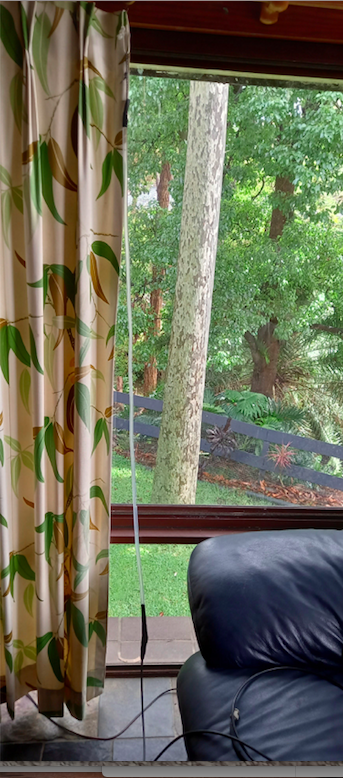
My holiday / travel antenna.A 2mtr J pole antenna (often called a Slim Jim) made from T.V. ribbon ( available from Jaycar) that is easily rolled up and put into a travel bag with a handheld and can be inconspicuously attached to a curtain rod or window frame of a hotel or holiday apartment.It works very well, here’s a link to a site for measurements. https://please.name.my/66/2-meter-amateur-radio-slim-jim-plan.html

Andy VK2EAH – outbacker
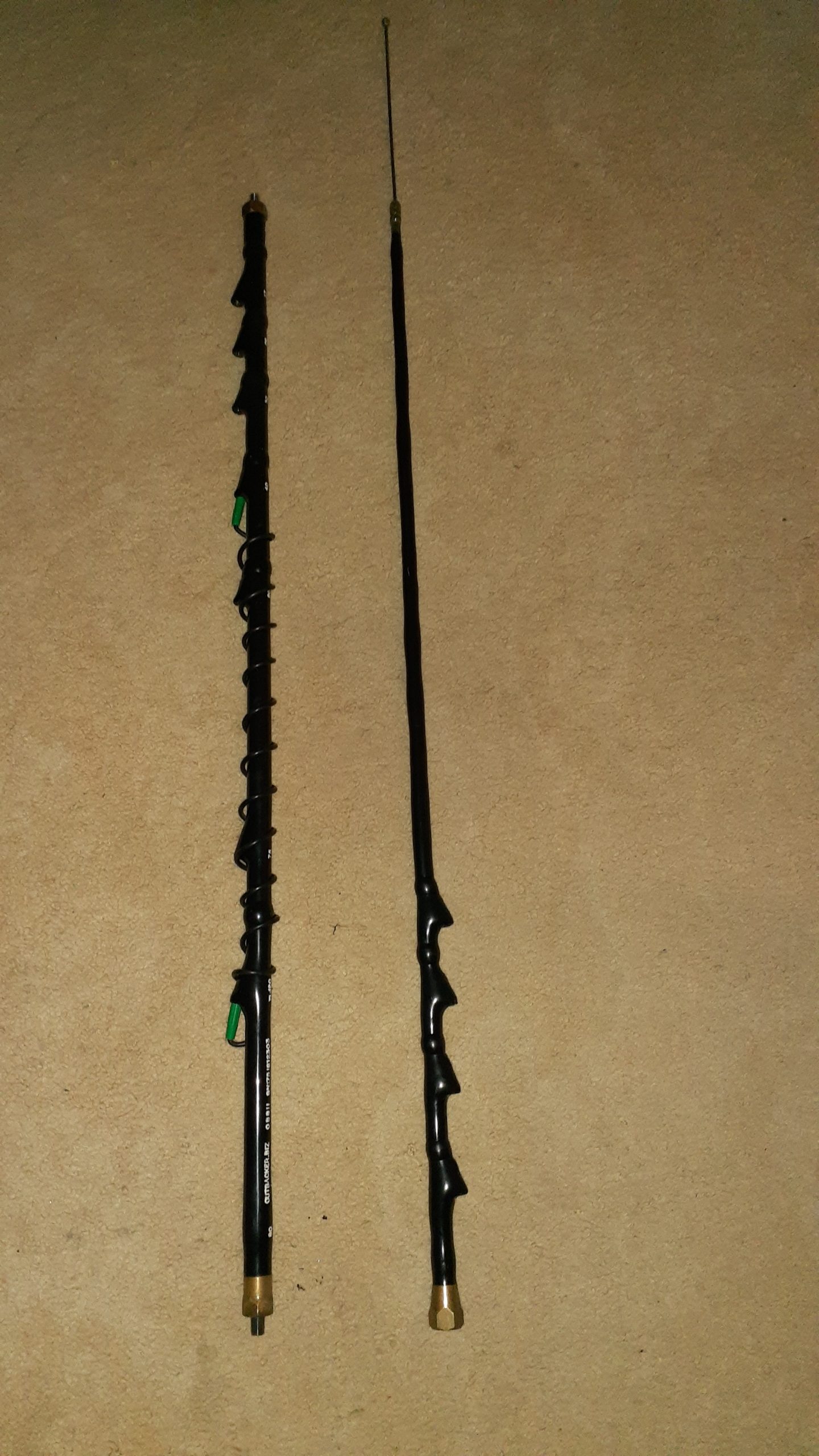
Terlin “Outbacker” multi-tapped helical whip for HF. Has taps for 75m, 60m, 40m, 30m, 20m, 17m,15m, 12m, 10m and 6m amateur bands. The “wander lead” is removed completely for operation on the 80m band. Once the band is selected the “stinger” tip is adjusted for best SWR. Breaks down into two pieces for easy stowage. Not shown in photo is the base and spring which is part of the system.
Geoff VK2TGO – End Fed

Nick VK2FS -septum feed for 23cm
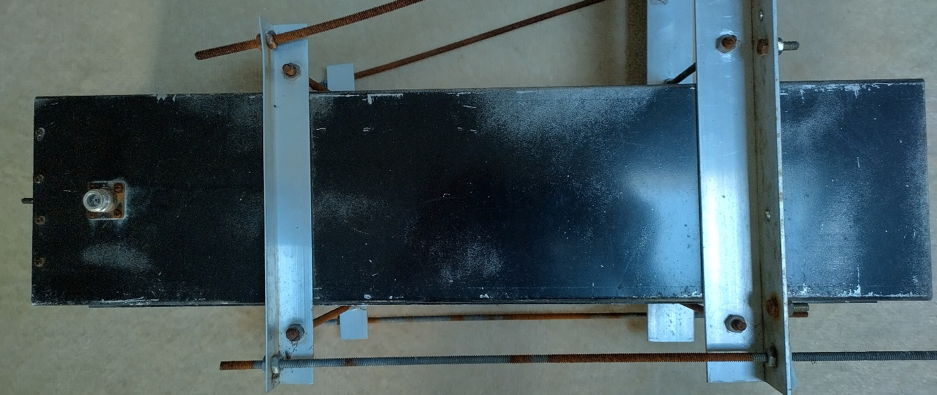
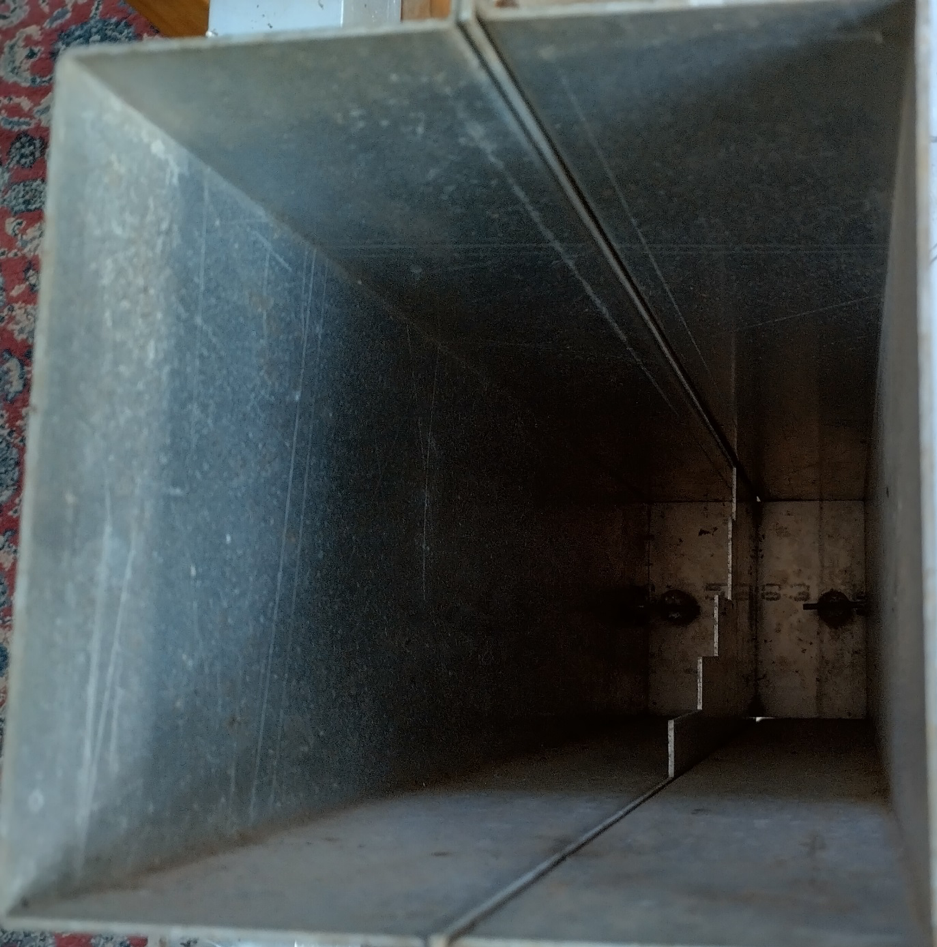
The Septum feed brought to the club is for 23cm. Different dimensions are required for each band.
The Septum feed is designed for use on EME (Earth Moon Earth) or Moonbounce communications. At 23cm the standard is to transmit a signal that is clockwise circular polarised. When the signal bounces off the moon, it comes back with the reverse polarisation. The Septum feed is designed with two sides and a precisely cut centre section which creates the correct polarisation for transmit and receive with separate antenna connectors for transmit and receive.
The Septum feed is positioned at the focal point of a parabolic dish. The separate antenna connectors allow for a pre-amplifier to be connected very close to the feed point to give the minimum loss in the coaxial cable between the receive aerial and the pre-amplifier. This is very important for EME communications where very low level signals are received. In the displayed feed, the receive antenna has a SMA type connector. On the transmit side, the aerial port is an N-Type connector which will have a low loss cable (e.g. heliax) running to the transmit amplifier to reduce transmit losses to a minimum.
Sean VK2THT – Traveller’s curtain aerial – adds a new meaning to curtain call!
Phil VK2JPK – phased helical
No Comments Yet