
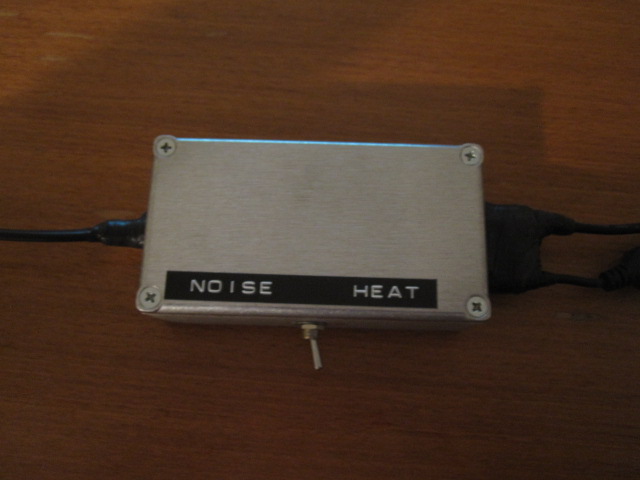
Two recent camping road trips where we relied on the travel time to charge our 2 phones convinced me to build a linear 5v power supply. We use an AM Airband radio in the car that is very sensitive to RF from typical switch modes phone chargers. The IDLA charger we bought even overrides our car FM broadcast radio and makes the scan feature unusable.
I used 2 x 7805 in a die cast box with 2 outputs, for 2 phones, however when the phone batteries are low and you use the phone GPS, the box gets really hot. So I decided to include a 5amp switchmode 12v-to-5v PSU in the box with a switch to toggle between the switchmode and linear PSU depending on the requirements/limitations.
I’ve labelled the switch: “noise … heat”. Select as required for the part of the trip!
===========================================
Hi Yves
Including that switch “noise / heat” is gold!! : – )
I too was faced by the same dilemma in deciding on a charging method for my recent Galaxy TAB tablet running a mapping programme in my 4WD. As we all know, operating *any* switch mode charger / voltage converter in a vehicle is simply unacceptable if you are trying to simultaneously operate HF and/or VHF! I was just not prepared to compromise my HF mobile-receive performance. As a consequence I decided to design and construct my own linear (ie completely RF noiseless) USB power supply running off the car battery (actually it has to be designed to operate off the vehicle’s alternator (ie say 14.2 volts input)). The output is 5v via USB, and I wanted to initially supply 1A. So with 14.2 input, 5V output and a 1A current – this means that a linear charger has to dissipate 9.2W. (This is quite a bit of heat). Again for this initial supply I did not want to use external heatsinks or fans, so I selected a diecast project case to mount it in, and rely on convection cooling off the thick diecast case.
I also decided to use a two stage regulator – for the second stage I used a 7805 regulator, and for the first stage I used a conventional 2N3055 / Zener diode regulator to supply 8v to the 7805. The advantage of this is:
1. A 2N3055 is a very rugged device and should easily handle starting transients etc off the alternator (maybe I am overly cautious, but I didn’t want to risk a power supply failure and present 14v on the USB rail, and destroy my brand new Galaxy tablet!!).
2. I mounted the 2N3055 on the opposite side of the case to the 7805 – in this way the two heat sources are distributed
3. I can include additional 7805 regulators off the single 2N3055 arrangement to supply additional USB outlets in the future
I next had to work out how USB charging “works” as I had heard that USB devices “communicate” to work out how much current a dedicated charging port (DCP) (to use its technical term), can supply. I am sure that we have all experienced various combinations of USB chargers / USB devices that will and will not charge correctly! I ignored the Apple devices (who cares about Apples proprietary operation anyway??). After some research (and subsequent mockup and measurements in the shack), I have confirmed that with DCP supplying non Apple devices:
1. With the D+ and D− lines open circuit, the USB device will draw a maximum of 500mA
2. With the D+ and D− lines short circuit, the USB device will draw a maximum of 1A
3. For the USB device to draw more than 2A, different voltages are required to be presented to the D+ and D− lines (more research required here)
So for my application, I set it up to supply 1A, and constructed my USB power supply based on the above, and after my recent trip to the Victorian High Country, I am 100% satisfied with it, and my design criteria. I used it to run my Galaxy tablet, and also to charge my Samsung S6 phone. It was powered up and running every time the engine was running, and on the warmer days (say 30 degrees ambient), the power supply diecast case was very hot to the touch (not quite burning hot, but very hot … as a guess say 55 degrees). This is all as per my design.
And zero additional noise on HF!!
What’s next? Next I may look at a 2A USB supply, but as the thermal capacity on my existing diecast case has been reached, in my next design I will need to introduce a heatsink and/or fan arrangement.
73, Tim VK2BT (16-Jan-2017)
=========================
You can actually get switched mode 7805 equivalents and if you mount them in a die cast case with proper bypassing, there is no noise ( and no heat!!!) – Horst VK2HL (16-Jan-2017)
Are the USB outputs suitable for apple thingy’s?
I haven’t tried! One of the output is terminated with a standard USB female, so I’m assuming it will supply the required 5v power to any Apple USB hock-up wires.